Showing posts with label majorproject. Show all posts
Friday, 29 April 2016
Martin Parr Exhibition
Martin Parr Exhibiton/ Own work
During the Easter holidays I visited the Martin Parr exhibition a the Hepworth gallery in Wakefield. Visiting this exhibition was a great experience and I felt I was able to take a lot from seeing Parr's work actually in an exhibition as appose to just on a computer screen or in a book. As I have mentioned previously within my research for this major project, Parr's work is something which is of great influence to me and my own work.
My work from my minor project focused heavily on bright saturated colours much like that of Parr's. At the moment in my major project, I have been torn between the use of colour or black and white. It was therefore really useful to see a range of Parr's work dating right from the earliest of his career to now.
The exhibition started with very old black and white documentary prints from the early years of his interest in photography. The images consisted of documentation of a church he was familiar with in his own life and other simple ideas of documentary work such as these. Evidently Parr was documenting whatever he could, simply for his own personal enjoyment. What I enjoyed about this particular work was that it was so different from the work I am personally familiar with and very different to the work Parr is really known for. It was brilliant to be able to see where he started and see how his style has changed through the years up to the work he is producing now.
The next work being exhibited focused heavily on probably his most famous work, from the 1980's or 'Thatcher period' as some refer to it as. Several pieces are on show from Parr's project, 'Last resort' where he documented Brighton beach. The images focus heavily upon the people here as appose to the area or and landscapes, which I felt was much like the work I have been producing; It wouldn't be what it is without the people who are in the images.
This particular work wasn't taken too lightly by some people at the time as it was said that it quite shockingly exposed working class people, in an unfair way. Parr's work isn't just about simply documenting people, a lot of his work focus' upon people in terms of consumerism and the british class system. These particular images taken on Brighton beach focus on the working class. However Parr was not intentionally wanting to expose these people in a negative light. He was rather just documenting this class as they were. Maybe he was drawn to the more shocking sights he saw and chose to document theses however his intentions were not to set out to document people negatively.
Following this work, the next images in his exhibition were the documentation of middle class people. As explained in the information provided in the gallery next to the work, Parr documented the middle class as it seemed to be a class no one seemed to take a great interest in. Especially in terms of photography. During this time in Britain, a heavy emphasis in the media was already created over the working class as the country watched Thatcherism treat the working class so unfairly.
I think Parr seems to be very good at documenting the ordinary and by doing so he manages to make it unordinary or extremely interesting. He photographed middle class people at 'Tory tea parties' and in the images we look upon what to me, look like typically british people, socialising, which to anyone on looking in that situation or if I were to see that kind of scene today, Id probably think nothing of it. British people having tea parities or just british people socialising is what we class as the 'norm'. However, the fact Parr thinks to stop and capture these moments as a still in his images, make them extremely interesting to look at as a photograph, as normally we would not look twice at these situations.
Again this is something which I felt related to what I've been trying to portray in my own photography. I feel this concept is what I am also naturally drawn to. For instance, my Minor project images focused heavily and if not completely on the ordinary situations you'd expect to see at an event such as that. I focused my images on people socialising and drinking, as appose to the actual event.
This is also something I had in mind and wanted to focus upon when shooting the images for my major project. I focused a lot of my shots on the celebration and the way people socialise at this event, which to most is something they would not look twice at.
The next lot of work presented by Parr I felt really changed my way of thinking or affected me was in two rooms, where Parr presented his most recent work where he had documented Wakefield's rhubarb farming and trade industry. Again, a heavy emphasis on colour is evident in Parr's work. Without the use of colour I do not feel the images would have the same impact. This has encouraged me to really think about my own work when it comes to the decision of whether to use black and white or coloured images.
This is therefore the reason Parr exhibited his work in the Hepworth at Wakefield. This work wasn't necessarily what was in the images which really got me thinking, it was in fact the way they had been presented in the exhibition. I took note of the layout and the way the exhibition had been curated throughout. Parr's earlier and more traditional style images shot on film were presented much larger than what I was expecting. The frames where white and for each section of the exhibition from his earlier work the images were matching in size and placed at eye height; the kind of level one would mostly expect to see in an exhibition of photography.
In the next rooms however, where the images focus heavily on consumerism and are of much more recent times the images did not have frames, they were simply pinned to the walls. This really surprised me and the layout surprised me even more so, the images were of various sizes and dotted in random places upon the walls. Some really up a height. I thought this layout so interesting and different. It wasn't what I was expecting at all but I felt it worked so well.
Another wall in one of the rooms had small images all exactly the same size, packed tightly together like a collage filling a vast amount of the wall. The images were all in the same style of close ups of materialistic and almost grotesque objects. Again, a project which was very consumer based and not just a project simply documenting something but trying to say more about people and the society we live in. The images are extremely bright and saturated, yet another project which almost completely relies on the emphasis and use of colour. This particular project had a real impact when you walked into the room and saw the wall covered in these images.
I really like how Parr had catered the layout of his images to what the projects or photographs were about or trying to say. Until visiting this exhibition I had never thought of any inventive ways to present my work. So this exhibition really left me with something to think about.
Friday, 22 April 2016
Berlin book
Researching Documentary photo books
As my Major project consists of the documentation of a particular event, and I want to tell the story of that event through the use of these images, I have decided the visual narrative should be made into a photo book. Creating a photo book for my minor project, where I made a small maquette version is something which I really enjoyed the process of and I felt it was something which suited my work so well and tied together my work perfectly. The images I have taken in previous projects and the work I will be producing during this project always seem to follow this style of visual story telling, therefore my images need to be shown as a collective as appose to a few individual images. I feel some work like this often needs contact behind it such as text or information to set the scene or tell the story before diving into the imagery. With the decision of creating a photo book now made, I want to research into different styles of photo books, preferably of documentary work of course.
I aim to look at all the aspects which need to be taken into consideration when making my own book such as the front cover, the shape or size of the book, colour of the cover or colour schemes throughout, whether to use text and finally how to layout the contents of the book for example text and the images.
I have been looking at this book by Mark Power, which is his documentation of the fall of the Berlin Wall. The way power sets the scene and gives more contact to the reader than just through the images them selves is with these newspaper cut outs which cover the front of the book and take up the first and last pages of the book. The news paper used on the front of the book is apparently a newspaper Power actually purchased the day after the wall had been pulled down.
" a newspaper Power purchased in Berlin the morning after."
http://www.markpower.co.uk/die-mauer-ist-weg
As can be seen in the image below, following the some news paper cut outs which really set the scene, inform them and takes them back to this time, there is text presented across a double page.
The situation power was in when over in Berlin taking these images is explained. Its incredibly interesting to hear his story and the reasoning behind the images. Without this text the images would be viewed in a very different way I feel.
What I liked about this book is the impact the images have by being spread across full double pages. Obviously with such an iconic and dramatic subject matter and point in history, way the images were presented had to give an impact too.
I like the fact just because some images are portray doesn't mean they couldn't be included in the landscape style book or that they should be presented in a standard way. The fact the portrait images are still presented across a double page and the viewer is encouraged to turn the book to view the image is something which I think works well. I personally wouldn't think to do this and would stick too much to a typical formal idea of having to have all the images presented the same way. The images I will be working with to create my own photo book are both landscape and portrait so this idea of a layout is definitely something I feel I should consider.
Obviously during the time this was project of images was made, film camera were what photographers used. So the fact these images are black and white I understand is completely unintentional however I like the way the images are black and white and the news paper cuttings are still visible throughout reading the book, not just on the front and back pages. Because the project is a documentary / photojournalistic style piece, when looking through the book as the viewer you feel as though you are reading a newspaper.
Saturday, 27 February 2016
Matthew Finn
Matt Finn
We have been lucky enough for the professional photographer Matt Finn to pay us a visit and give us a lecture on his work and his career over the years. Matt Finn is a British documentary photographer who actually went to university with one of my tutors, Jamie. Matt's work seems to focus most upon documentary portraiture. The majority of his work is on black and white film however he has produced some colour work, however this is also on film. Matt explained to us that when he was a student, film photography is what was used and he has carried on to do that through his career as film is what he knows and feels comfortable with using.
What I enjoyed most about Matt's talk with us other than his brilliant photography, was the fact I felt he was very realistic in terms of when he was speaking about leaving university and the concept of find a job or making a living off photography. As I am in my final year now and due to soon graduate from Uni, the fear of finding a job when I leave is constantly growing. Matt was honest with us and said its natural to be worried about leaving and worried about what we will do next, as he said he too was like this. He explaind how from leaving university he went on to work at an arts school to make some money. While working there he created his own work just for his own personal use at the time. this particular project is one of the only projects he has present on his site. The project was called 'Students'. In this project Matt simply captured portrait style images of students where he was working.
It's really interesting to see Matt's very early work. He explained he still felt after leaving university he didn't know much about the technical side of photography, he just liked to take photographs. I really liked this honesty as i felt its inspired me just go out and make images, as appose to thinking I'm not up to a certain standard or level and letting that hold me back. The images of students I find are really interesting. I like the relaxed poses of the girls and how when they are presented as a collective, each individual person makes every image so very different, in terms of the variations in looks and style/fashion.
Matt's next two projects which are on his website which he showed us and spoke about was the documentation of his mother and his uncle. Matt explained how upon graduating and being a young photographer in the world of work, he chose to photograph something he knew he was comfortable with photographing. Something that was easily accessed and two people he knew he could easily photograph was his mother and uncle. He explained how by photographing his mother and uncle he could build his confidence with a camera and build his experience and technique. The project ended up lasting for years, Matt photographed his uncle for many years up to the last stages of his life in the house. The same goes for his mother.
What really makes Matt's work, work so well, besides the brilliant skill he evidently had to take these images, is how the images work so well as a collective. It is amazing to watch his home and his mother change over the years. As she ages and fashion changes, the viewer is taken through that journey. Matt's closeness with his mother is also very much so felt through the images as she looks so natural and used to him taking photographs of her.
As Matt explained, he created these bodies of work over a span of about 20 years. He explained how his wife entered his work into a competition without him knowing, he then won the competition which was in 2014, meaning from then on his career has really taken off. With many different agencies or companies wanting to publish his work. Matt explained how creating projects that span over many years are great but not exactly ideal if you want to make a living from your photography straight away. I personally think having other jobs on the side would be ideal whilst creating a project that spans over time. I felt his work was incredibly interesting and it really has inspired me to keep in mind creating a documentary project which spans over a period of time.
Portfolio Review
After hearing Matt speak about his own work, I was lucky enough to get Matts opinion on my own work. I showed him my Machete book which I've made for my major project and some A4 sized prints I had done. The images I used for this were black and white. Despite the fact the images I took for my Major project were documentary style coloured images, I changed the images to black and white as I personally felt the images had more of an impact in this form. However when showing my work to my class previous to Matt visiting University, my class suggested I keep the images in colour. Matts opinion was to go with my instinct and said he liked my images in black and white and felt they worked well. He particularly liked the handmade book I had made, as a way of visually telling the story of the days events I had photographed. It was really useful to have his opinion on my work as he gave me confidence to carry on the path I had been going on with the work.
Matt then encouraged me to think about how I would present the work in my final exhibition rather than just focusing on the project itself. This was good as I found I hadn't even began to think about how I would present the work in an exhibition in terms of what photographs Id choose, how many Id use and what size I would like them.
Friday, 12 February 2016
Sedgefield Ball Game
I felt the photographing of sedgefield ball game went really well. As can be seen in my previous research, I was able to capture a vast amount of photographs that day. I have a lot of great photographs to work with and the event itself is deffinately the most interesting event I have managed to photograph during my major project. This is therefore the reasons I want to use this particular event as the one I make a book out of. Here are some of my most favourite images from the shoot.
These images are only a select few from the day. I shot the day beginning from end paying attention to everything from documenting the actual playing of the game to the locals watching, socialising and celebrating. This can be seen in the above images I have presented. There is evidently a vast range of subject matter within the images.
Monday, 8 February 2016
Sedgefield Shrove Tuesday Ball Game.
Orignal plan
Prior to Sedgefield Ball game when I was planning my shoot, I took time to sit and discuss my work and my intentions with my tutor. When looking back over my previous work which has always naturally followed a documentary style, I started to notice traits within my images which reoccurred throughout different shoots. I came to notice that majority of my work focus' heavily on people. I also noticed that when photographing events I appear to naturally be drawn to the concept of people socialising and being caught off guard at such events.
Picking up on this trait was vital in helping me move forward with my photography. With these traits in mind which I feel define my own personal work as a photographer, I wanted to make sure I carry on to emphasise and focus on these aspects which my eye often seems to be naturally drawn to. I feel these aspects in my documentary style photography are what could be what make me different and unique to many other photographers.
With the main focus of Durham Miners gala being a march to remember the Miners and any trade unions of today, large banners are marched through the city.
An example of my own work can be seen below. I feel my own work tends to be more lighthearted and focus' on people and the social aspect of the day. This wasn't something I actually intended to do, or something I went out with the intuitions to capture. It was in fact just what I was naturally drawn tho. This is therefore what I intend to carry on capturing in future projects.
Saturday, 6 February 2016
Sedgefield Ball game
The Ball Game photography
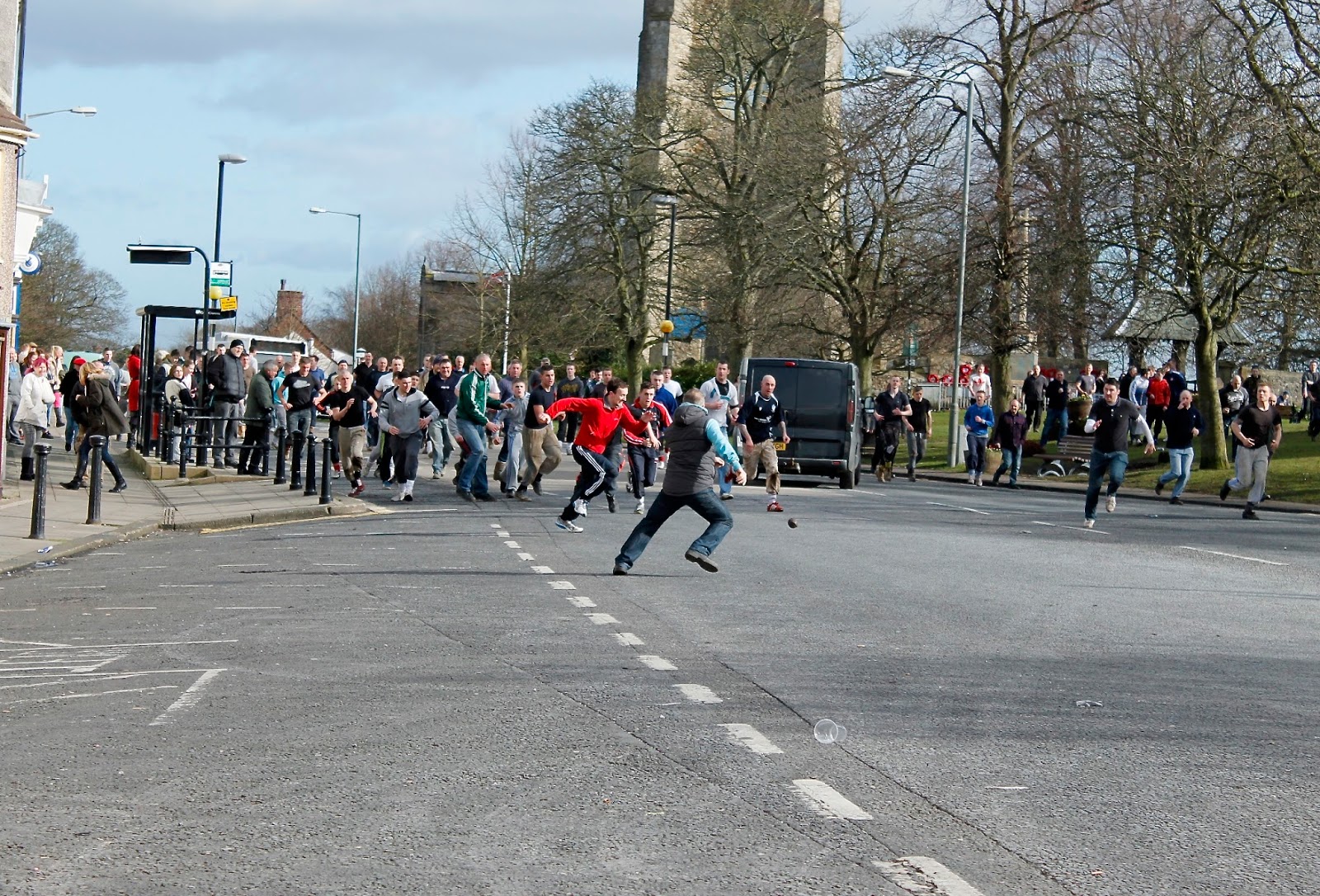
The majority of photography seen of Sedgefield ball game focus' upon the main event which is of men running around the village brawling with each other over the small leather ball in which they have to chase. Because the event is such a unique event in terms of what it is and in the terms that it only happens once a year, many news reports come to capture the days events.
The game does not tend to be captured by many documentary photographers, maybe because it is so unique it is not known about by many or maybe it is because it is such a tough event to photograph. Either way, this means that the only photography that is really captured on this day is by news reporters, meaning the style of photography is very photojournalistic and is captured to serve only one purpose, to inform people.
As can be seen with one simple google search of the game, the majority of photographs taken appear to be exactly the same. These images which appear on google are taken from several different years and by several different photographers yet they all look cry similar. In a previous post where I researched the photographer Stephen Curry, a slightly different approach to photographing the game or days events can be seen.
Because of this heavy focus upon a more photojournalistic style approach to capturing the days events, I wanted to try and capture the day in a different style. With being from Sedgfield myself and knowing this game and the people who get involved fairly well, I wanted to use this to my advantage and capture not only images of the men playing the actual game but what goes on in the background of the game itself. Whether I was coming to photograph this days events or not, it is an event I would have been attending regardless. With the aim to watch the game myself, social with my friends and cheer on my relatives who are also taking part in the event. I understand the game and have attended it almost every year I have been able to, however I understand that to anyone who is not from this area, it can be an event which is difficult to grasp or understand. With the documentation of this event only really ever being of the men brawling with each other and chasing the ball, and these images only ever really being exposed in the news, to any outsiders who may not be familiar with this game, what the news shows or google searches such as this, are all they can really go on to try and get an understanding.
Throuhg being a local to the village and regular attender of the game however, I understand that there is much more to the game that what photographers or photojournalists seem to portray. While the men fight, the less fit or able who can't take part in the game such as the elderly, young children or often women come to watch the game while socialising by drinking in the local pubs and whiting the game from the side of the road or from the comfort of the pubs. The day really is a day of celebration in the village and it is something so many of the people who live here look forward to every year.
I therefore wanted to try and capture this in my images as many of the photographers and new reporters who attend the days events do not have the access I do to the locals or culture/ social aspect of the day. Many of the local who I know feel comfortable with me being around them with a camera so I knew this would be a great opportunity to try and capture a more interesting and honest portrayal of the days events from someone who actually live in Sedgefield.
Thursday, 4 February 2016
Other photographers
Shrove Tuesday
Sedgefield Ball Game photography
Edge of humanity
http://edgeofhumanity.com/2016/02/07/ball/
In the lead up to the event Sedgefield Ball game this year I have came across this article by 'Edge of humanity magazine'. The article explains a bit about Sedgefield Ball game and presents some brilliant black and white images by the photographer Stephen Curry.
Stephen Curry is a documentary photographer who has captured images of Sedgefield Ball game for many years. His images are black and white and mix between a range of close up action shots and more intimate portrait pictures of the players themselves. His images tell the story of the ball game over a range of years and show a sense of the enjoyment and happy spirits the men who take part in the game have as well as showing the rough and dangerous side of the days events.
These images were taken this year at Sedgefield's Shrove tuesday ball game on 9th February 2016. His full archive of images from Sedgefield Ball Game which span over the years are all in monochrome. I like the way the images are in black and white as this seems to add more to the feel of narrative in the images. Making all the images the same tonal colours help the images as a collective flow better. I feel the viewer is more focused on the story throughout that the images are portraying as a whole for the event as appose to just focusing upon one particular image. I feel the black and white adds to the idea of this being a traditional narrative. The black and white gives a more traditional feel to the images. The pain, blood, sweat, tears and laughter I feel can also be felt more when viewing the images in black and white as this makes the images more serious and there is no distraction with bright colours caused. What I really like about this photographers work when capturing Sedgefield Ball game is the fact its different to other photographs that are produced from this day each year as most other photographers are not there to produce personal projects such as Stephen Curry, but they are more so there so to produce journalistic style images ready for the use of informing people in newspapers and on online articles.
From looking at Stephen Curry's work you can tell photographing this game is something he has mastered over the years. These images are great up close and personal shots. I don't feel someone photographing this game for their very first time or someone who is not confident with what the ball game is about could capture images such as these. The raw emotion and struggle which the men go through in order to win the game is evidently captured here. Being able to get this close to the men is something I know i would struggle with myself.
Shrove Tuesday Event
Sedgefield Ball Game, previous work:
As february approaches, following my trips to various locations during January, a unique yearly event in my home town of Sedgfeild, in county durham is about to commence. Each year on shrove tuesday an event called 'Sedgefield ball game' takes place. This event is something which i a familiar with and is something I have attended every year for almost all my life. This event is the perfect interesting and busy kind of event I have been looking for photograph since starting my major project. I have photographed the event before and I am familiar with the days events and the majority who attend.
To try and best explain what 'Sedgefield ball game' really is, here is a brief explanation...
http://www.gazettelive.co.uk/news/teesside-news/watch-mayhem-madness-annual-sedgefield-10863643
"It’s a game of few rules which has been around for more than 900 years but it is definitely not going out of fashion. The annual Sedgefield ball game - played every Shrove Tuesday - was under way today with dozens of locals taking part. The ball game started at 1pm, when a four inch diameter leather ball is passed through a metal ring on the village green. The players then kick the ball through the village to the streams where it must be placed three times then back through the ring before sundown. The free-for all battle attracted scores of onlookers who enjoyed the chaotic spectacle."
The event is unique to Sedgefield and is therefore seen as a very intereting event and tradition to anyone not from the area. Many photographers and journalists come to the village to also photograph the event. As I found when photographic Durham miners gala, I found I felt more at ease when photographing an event when a person with a camera was not seen as unusual.
Here are some of the images I produced from Sedgefield shrove tuesday ball game 2016.
There is a vast range of shots which I produced from this day however upon reflection, this images above and the image below work very well in my opinion. The focus of the images are of the people watching the event. The audience or the passers by. I like the way I have managed to capture the drama of the day by capturing the people viewing the game as appose to focusing my images on the games itself.
The style of these images are exactly what I would hope to produce again at this years event. However I understand that in order to tell a visual story of the days events, especially in a photo book, I think it will be quite vital to include at least some images of the actual game itself being played in order to make the visual narrative make sense to people viewing the book or images with no knowledge of this game or event.
What I have always really enjoyed about covering an event by taking images is the way at the end the images can be put together to tell a story. I used these particular images to create a presentation for my peers in which i edited the images down and presented a selection in order from beginning of the day to the end, telling the story of my version of the days events. I felt these images worked really well in colour so when coming to photograph this years shrove tuesday ballgame I aim to do the same.
Subscribe to:
Posts (Atom)